
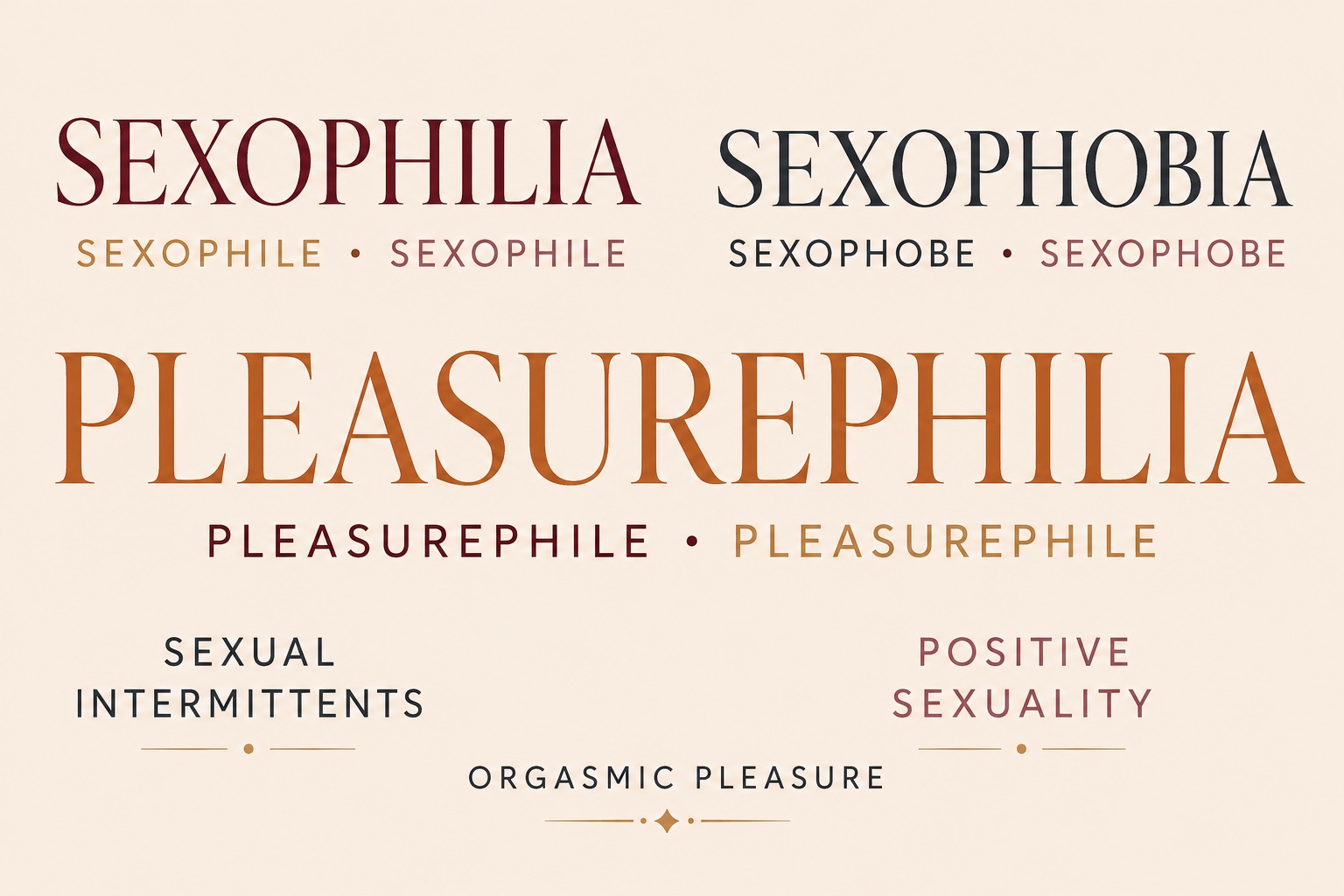
Sexophile is the term used by sexologist Iv Psalti to refer to a person who is interested in sex and enjoys their sexuality.
Sexophobe, despite what the word may suggest, does not necessarily mean that someone hates or fears sex. Psalti uses the term mainly to refer to someone who shows little or no interest in maintaining an active sex life.
Between the two, he places the “intermittent sex people”: people whose interest in sexuality may appear, disappear, or change depending on the stage of life they are going through.
I did not know any of these terms.
I discovered them a few days ago, as I usually do, while listening to one of Brigitte Lahaie’s podcasts on Sud Radio. The programme was in French and was specifically discussing what happens when a sexophile meets a sexophobe.
Because I did not know these words and, when hearing them in French, I could not completely understand everything they were explaining, I wanted to find out exactly what they meant.
And when I understood them, I found the subject really fascinating.
But it also immediately made me think about something connected to my own sexuality and to what I have been observing for many years in my work:
Does liking sex a lot necessarily mean that you know pleasure?
For me, no.
And another, even more personal question came to me:
What happens when you become less and less interested in sex, but more and more interested in pleasure?
Because that is exactly what is happening to me.
Sexophiles, sexophobes and intermittent sex people
Iv Psalti has been using these concepts for years.
In his article La Sexualité Positive : un outil pour atteindre la compétence sexuelle, published in 2016 in the journal Sexualités Humaines, he develops his concept of positive sexuality and uses this classification.
On one side, there are people who like sex, called sexophiles.
At the other extreme are people who have little or no interest in sex, the sexophobes.
And between these two groups he places the intermittent sex people.
What is interesting is that Psalti himself points out that these categories are not closed compartments. Our relationship with sexuality can change, and the same person can move between different degrees of sexophilia throughout their life.
You can read Iv Psalti’s original article on positive sexuality here.
So, what does it mean to be a sexophile?
Being a sexophile does not simply mean having a lot of sex.
I think this distinction is important.
Sexophilia has to do with the place sexuality occupies in our lives: our interest in it, desire, fantasies, masturbation, sexual relationships and the possibility of obtaining pleasure through our sexuality.
Psalti develops this idea within what he calls positive sexuality, whose objective is related to sexual well-being and learning how to give, receive and obtain pleasure.
And this part of his approach particularly interests me because it matches something I have been observing for years: having sex does not automatically mean learning about sex.
We can accumulate experiences for years and continue repeating practically the same things.
And what does it mean to be a sexophobe?
I want to stop here for a moment because the word itself can be confusing.
When we hear “sexophobe”, we may immediately imagine someone who hates sex, is afraid of it, considers it immoral or feels an aversion towards it.
But that is not exactly how Psalti uses the term.
In his approach, a sexophobe is essentially someone with little or no interest in having a sex life.
And that must also be respected.
A person may discover that sexuality simply does not occupy an important place in their life.
This is not about deciding who is right and who is wrong, nor about establishing that being a sexophile is better than being a sexophobe.
It is about understanding the relationship each person has with their own sexuality.
What happens when a sexophile meets a sexophobe?
This was precisely the subject of the podcast that sparked my curiosity.
Brigitte Lahaie and Iv Psalti have spoken about sexophilia and sexophobia on Sud Radio on different occasions, and in the programme I was listening to, they discussed what happens when two people who are in very different places regarding sex form a couple.
One person wants sex.
The other does not.
One is looking for sexual encounters, contact, desire and exploration.
The other may live perfectly well without it.
This does not necessarily mean that one loves the other more.
Nor does it mean that one is sexually better than the other.
But it does mean that there is a difference that does not simply disappear by ignoring it.
When these differences are not addressed, one person may begin to feel rejected, while the other begins to feel pressured.
And, from pressure or rejection, it is very difficult to build pleasure.
You can listen to Brigitte Lahaie’s programme on Sud Radio.
But while I was researching, another question came to me
So far, we can talk about how interested we are in sex.
But something is missing for me.
Where does pleasure fit in?
Because, after all these years of experience, I have learned to separate things that for a long time I experienced as if they were one and the same.
First, I discovered sexuality.
Then I discovered orgasm.
And much later, I discovered what I would now call orgasmic pleasure.
It has not been the same thing.
I knew sex before I knew orgasm
I had my first orgasm at 27 years old.
Of course, before I was 27 I already knew sexuality. I had had sexual experiences, but having sex was one thing and discovering what my body was capable of feeling was something very different.
And I cannot compare that first orgasm with the pleasure I am capable of experiencing now.
Over the years I have learned so much more about my body: how it responds, how sensations change, how to prolong them, how to control them and how to use toys as tools to explore and develop my own pleasure.
That is why, for me, even orgasm and orgasmic pleasure do not mean exactly the same thing.
Having an orgasm is one thing.
Knowing your body, exploring sensations, learning how pleasure increases, how to maintain it, how to play with it and discovering how far it can go is something completely different.
And what is curious is that, while my knowledge of pleasure has increased, my interest in sex has decreased.
I am becoming less interested in sex and more interested in pleasure
This may seem contradictory within a classification between sexophiles and sexophobes.
But that is exactly how I feel.
Every day, I am less interested in sex for the sake of sex.
What really interests me is pleasure.
Giving pleasure.
Receiving pleasure.
Exploring the body.
Observing how it responds.
Discovering sensations.
Developing orgasmic pleasure.
And enjoying the whole process.
So I asked myself a question:
Where does a person fit when they are less and less interested in sex, but increasingly interested in pleasure?
Because if we used only interest in sex as a reference, perhaps we could think that I am becoming less sexophile.
And that is probably true.
But that does not mean my interest in pleasure has decreased.
Exactly the opposite has happened.
And then another word appears: pleasurephilia
While looking for a way to express this difference, a much less well-known word appears:
pleasurephilia.
And the person would be pleasurephilic.
The suffix -philia expresses an affinity, inclination or attraction towards something, while -phile is used to describe a person who feels that inclination.
Therefore:
pleasurephilia → an inclination or particular interest in pleasure.
pleasurephilic → a person who is particularly interested in pleasure.
I want to make something very clear: pleasurephilia is not a clinical category or an established term in sexology, and I do not want to present it as such.
I am not talking about a paraphilia either.
It is a colloquial word that I find particularly interesting because it allows us to give a name to something that the distinction between sexophile and sexophobe does not fully explain.
And here I want to give it a slightly more specific meaning.
What do I mean by being pleasurephilic?
For me, being pleasurephilic does not simply mean constantly seeking pleasant sensations.
When I talk about pleasurephilia, I mean a conscious interest in knowing, exploring, developing, giving and receiving bodily pleasure, regardless of how much sex you want to have.
It is not only about seeking orgasms.
It is about knowing the body.
Developing sensitivity.
Being curious.
Learning how to receive.
Learning how to give.
Observing.
Listening.
Experimenting.
And understanding that pleasure can be much broader than simply carrying out certain sexual practices.
That is why, if I had to define myself today, I would probably say: I am more pleasurephilic than sexophilic.
I am much more interested in pleasure than in sex itself.
And I think this difference is important.
You can be very sexophilic and know very little about your own pleasure
A person can be extremely sexophilic.
They may have been having sex for twenty or thirty years.
They may have had dozens of partners.
They may masturbate regularly.
They may have many fantasies.
They may try toys.
They may know countless sexual practices.
They may talk about sex without embarrassment.
And yet they may know surprisingly little about their own body or the bodies of the people with whom they share their sexuality.
Because accumulating experiences is not necessarily the same as learning from them.
This difference is fundamental to the way I understand Sex Coaching.
I am not interested in counting how much sexual activity you have had.
I am interested in knowing what you have learned about your body during all that time.
Being interested in sex is not the same as being interested in pleasure
Here I think we can begin to separate several things.
Interest in sex.
Sexual desire.
Ability to experience pleasure.
Knowledge of your own body.
Ability to give pleasure.
Orgasm.
Orgasmic pleasure.
They are obviously related.
But they are not exactly the same thing.
You can have a great deal of interest in sex and little knowledge about your own pleasure.
You can have little interest in having sex and enjoy bodily pleasure enormously.
You can reach orgasms and still know very little about the possibilities of your body.
And you can have had a great deal of sexual experience without necessarily having learned to interpret the pleasure of the person in front of you.
Do you really know your body?
This is a much more difficult question than “Do you like sex?”.
Do you know exactly what kind of contact gives you pleasure?
Do you recognise how your arousal changes?
Do you know how to communicate what you want without expecting the other person to guess?
Do you know the differences between arousal, desire, pleasure and orgasm?
Do you experiment or repeat?
Do you observe the responses of the body in front of you?
Do you change what you are doing when those responses change?
Because no body comes with an instruction manual.
What worked wonderfully with one person may not work with another.
Even something you wanted yesterday may not be something you want today.
That is why I consider curiosity to be one of the most important tools in our sexuality.
I talk specifically about this process of self-knowledge in “The 7 stages to getting to know your sexuality and enjoying pleasure more”.
Knowing many sexual practices does not mean knowing how to give pleasure
We live in a time when we have access to an enormous amount of information about sex.
We know the names of practices, positions, toys and fantasies that previous generations probably had never even heard of.
But having information does not mean having practical knowledge.
You can know a hundred sexual practices and not know how to interpret a breath.
You can have seen thousands of sexual images and not know how to touch a body.
You can know a technique perfectly and still not realise that the person in front of you is not enjoying it.
For me, learning about sexuality begins precisely when we stop trying to demonstrate what we know and start paying attention to what is actually happening.
Having an orgasm does not mean knowing pleasure either
This difference is especially important to me because of my own experience.
I know what it is like to go from not knowing orgasm to discovering it.
But I also know what it is like to go from knowing orgasm to knowing my pleasure much better.
And it is not the same thing.
That is why I do not consider orgasm simply a goal that has to be reached.
I am interested in everything that happens around it.
The journey.
The sensations.
The intensity.
Bodily awareness.
Control.
The ability to let go.
Exploration.
And the possibilities we discover when we stop thinking only about “getting there”.
That is why I talk about orgasmic pleasure and not simply orgasm.
There is no single correct way to experience sexuality
I also do not want to turn sexophilia — or now pleasurephilia — into a mandatory goal.
I do not believe that everyone has to want more sex.
Nor that we should practise more.
Nor experiment more.
Nor have orgasms constantly.
Nor seek pleasure in a particular way.
Nor meet any supposed model of sexual freedom.
For me, sexual freedom also means being able not to want. Being able to say yes. Being able to say no. Being able to change your mind. Being able to discover something new. And being able to recognise that something we thought we were supposed to like, in reality, we do not like.
No one has to become a sexophile. And no one has to become pleasurephilic either.
And what if someone is interested neither in sex nor in pleasure?
That can happen too.
I do not want to make the opposite mistake and think: “If they really knew pleasure, they would surely like it.”
Not necessarily. Everyone experiences their body and sexuality differently.
There are people for whom sex occupies a central place and others for whom it has practically no importance.
And there may also be people who have no particular interest in exploring sexual or bodily pleasure.
That does not automatically mean that they have a problem or that they need someone to teach them what they are supposedly missing.
Knowledge of pleasure makes sense when there is curiosity or a desire to discover it.
Can we change our relationship with sex and pleasure?
One of the things I like most about Psalti’s approach is that he does not present his categories as unchanging identities.
Our sexuality changes. Our body changes. Our relationships change. Desire changes. And our relationship with pleasure can also change.
My own experience is an example.
I do not experience sexuality today in the same way I did before my first orgasm. And I do not experience pleasure today in the same way I did when I discovered that first orgasm at 27.
I have continued learning. And I hope to continue doing so.
We can learn to communicate. We can get to know our bodies better. We can let go of ideas that no longer serve us. We can discover new pleasures. We can learn to receive. And we can learn to listen much better to the body of the person in front of us.
In SexCoachOnline, I work precisely from that place: practical sex education, body awareness, communication and pleasure, rather than from the idea of imposing what anyone’s sexuality should look like.
If you want to work on your sexuality individually or as a couple, you can explore my options for Online Sex Coaching for couples, consult the personalised training in sex education and intimate well-being or discover my online workshops on sexuality and pleasure.
So, are you a sexophile, sexophobe… or perhaps pleasurephilic?
Maybe, after reading this, you have a fairly clear idea of where you would place yourself in Iv Psalti’s classification.
Maybe you are a sexophile. Maybe a sexophobe. Maybe one of those intermittent sex people. Or perhaps, as happens to me, you discover that this classification leads you to another question.
How much am I interested in sex and how much am I really interested in pleasure?
Do I know my body? Do I know my pleasure? Do I know how to receive it? Do I know how to give it? Am I still curious? Do I know how to communicate what I want? Do I know how to listen to the pleasure of the person in front of me? Have I learned from all my sexual experiences or have I simply accumulated them?
Because we can spend an entire lifetime having sex without asking ourselves any of these questions.
And for me, that is one of the great differences between having sexual experiences and learning from our sexuality.
I discovered sexuality first. Then I discovered orgasm. And afterwards I discovered an entire world around pleasure.
Perhaps that is why today I can say something I probably would not have understood years ago: I am less and less interested in sex for the sake of sex and more and more interested in pleasure.
And if I have to give it a name: I am pleasurephilic.